Email Novel Suspects Logo
Hachette provides comprehensive global distribution services in the following territories:

United States flag Switch to United States region United Kingdom flag Switch to United Kingdom region Australia flag Switch to Australia region India flag Switch to India region

Hachette Book Group menu

  • Home
  • Publishers
  • Customers
  • Sustainability
  • Retailer Portal
  • Location
  • Our Culture
  • Our Careers
Go to Hachette Book Group home

Hachette Book Group menu

  • Home
  • Publishers
  • Customers
  • Sustainability
  • Retailer Portal
  • Location
  • Our Culture
  • Our Careers

By clicking “Accept,” you agree to the use of cookies and similar technologies on your device as set forth in our Cookie Policy and our Privacy Policy. Please note that certain cookies are essential for this website to function properly and do not require user consent to be deployed.

Why Does E=mc2?

(And Why Should We Care?)
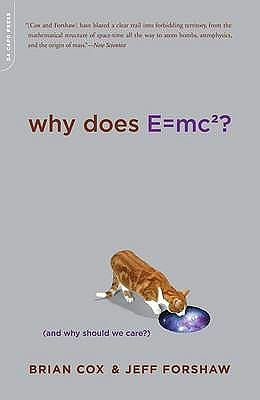
Why Does E=mc2? Open the full-size image

Loading

Contributors

By Brian Cox

By Jeff Forshaw

Formats and Prices

On Sale
Mar 9, 2010
Page Count
272 pages
Publisher
Da Capo
ISBN-13
9780306819117

Price

$15.95

Price

$17.99 CAD

Format

  1. ebook
  2. Trade Paperback

Format:

  1. Trade Paperback (Special Edition) $15.95 $17.99 CAD
  2. ebook $9.99 $12.99 CAD
  3. Trade Paperback $18.99 $24.99 CAD

Buy from Other Retailers:

  • Amazon
  • Barnes & Noble
  • Books-A-Million
  • Bookshop
  • Target
  • Walmart

The international bestseller: an introduction to the theory of relativity by the eminent physicists Brian Cox and Jeff Forshaw

What does E=mc2 actually mean? Dr. Brian Cox and Professor Jeff Forshaw go on a journey to the frontier of twenty-first century science to unpack Einstein’s famous equation. Explaining and simplifying notions of energy, mass, and light-while exploding commonly held misconceptions-they demonstrate how the structure of nature itself is contained within this equation. Along the way, we visit the site of one of the largest scientific experiments ever conducted: the now-famous Large Hadron Collider, a gigantic particle accelerator capable of re-creating conditions that existed fractions of a second after the Big Bang. A collaboration between one of the youngest professors in the United Kingdom and a distinguished popular physicist, Why Does E=mc2? is one of the most exciting and accessible explanations of the theory of relativity.

Genre:

  • Nonfiction
  • Science
  • Physics
  • Relativity

Brian Cox, OBE, FRS, is a Professor of Particle Physics at the University of Manchester and the Royal Society Professor for Public Engagement in Science. His many highly acclaimed BBC television documentaries include, most recently, Human Universe and Forces of Nature.

Jeff Forshaw is a Professor of Theoretical Physics at the University of Manchester, specializing in the physics of elementary particles. He was awarded the Institute of Physics Maxwell Medal in 1999 for outstanding contributions to theoretical physics.

You May Also Like

General Relativity
General Relativity $21.99 $28.99 CAD
The Gravity of Math
The Gravity of Math $32.00 $41.00 CAD
Exercises for the Feynman Lectures on Physics
Exercises for the Feynman Lectures on Physics $24.99 $32.99 CAD
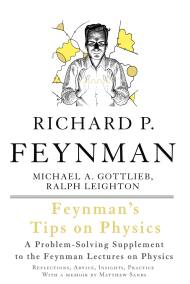
Feynman’s Tips on Physics
Feynman’s Tips on Physics $18.99 $24.99 CAD
The Feynman Lectures on Physics, boxed set
The Feynman Lectures on Physics, boxed set $250.00 $315.00 CAD

Brian Cox

About the Author

Brian Cox, OBE, FRS, is a Professor of Particle Physics at the University of Manchester and the Royal Society Professor for Public Engagement in Science. His many highly acclaimed BBC television documentaries include, most recently, Human Universe and Forces of Nature.

Jeff Forshaw is a Professor of Theoretical Physics at the University of Manchester, specializing in the physics of elementary particles. He was awarded the Institute of Physics Maxwell Medal in 1999 for outstanding contributions to theoretical physics.

Learn more about this author

Jeff Forshaw

About the Author

Jeff Forshaw is a Professor of Theoretical Physics at the University of Manchester, specializing in the physics of elementary particles. He was awarded the Institute of Physics Maxwell Medal in 1999 for outstanding contributions to theoretical physics.

Learn more about this author

▲
HBG Distribution logo
  • FAQ
  • Vendors
  • Cookie Policy
  • Report Piracy
  • Fraud Alert
  • CPSIA
  • GPSR
© 2026 Hachette Book Group | Terms of Use | Privacy Policy | Contact Us | Do Not Sell My Personal Information